Trajectory-Conditioned Joint Embedding Prediction for Surgical Instrument-Tissue Interaction Recognition in Vision-Language Models — IROS 2026
TrajPred encodes instrument trajectories to inject temporal motion cues into Vision-Language Models, then uses a trajectory-conditioned predictor to generate visual semantic embeddings that capture fine-grained action details. With prompt tuning and a verb-rephrasing technique for task adaptation, TrajPred improves instrument–tissue interaction recognition on CholecT50 in both Average Precision and Top-K accuracy.
Recognizing instruments' interactions with tissues is essential for building context-aware AI assistants in robotic surgery. Vision-language models (VLMs) have opened a new avenue for surgical perception and achieved better generalization on a wide range of tasks compared to conventional task-specific deep learning approaches. However, their performance on instrument–tissue interaction recognition remains limited, largely due to two challenges: (1) many models do not effectively leverage temporal information, and (2) alignment between vision and text often misses fine-grained action details. To address these issues, we propose TrajPred, a framework that encodes instrument trajectories to incorporate temporal motion cues; and conditioned on these trajectories, introduces a predictor module to generate visual semantic embeddings that better capture fine-grained action details. We further incorporate prompt tuning and a verb-rephrasing technique to enable smooth adaptation to the instrument–tissue interaction recognition task. Extensive experiments on the public laparoscopic benchmark, CholecT50, show that our method improves both Average Precision and Top-K accuracy.
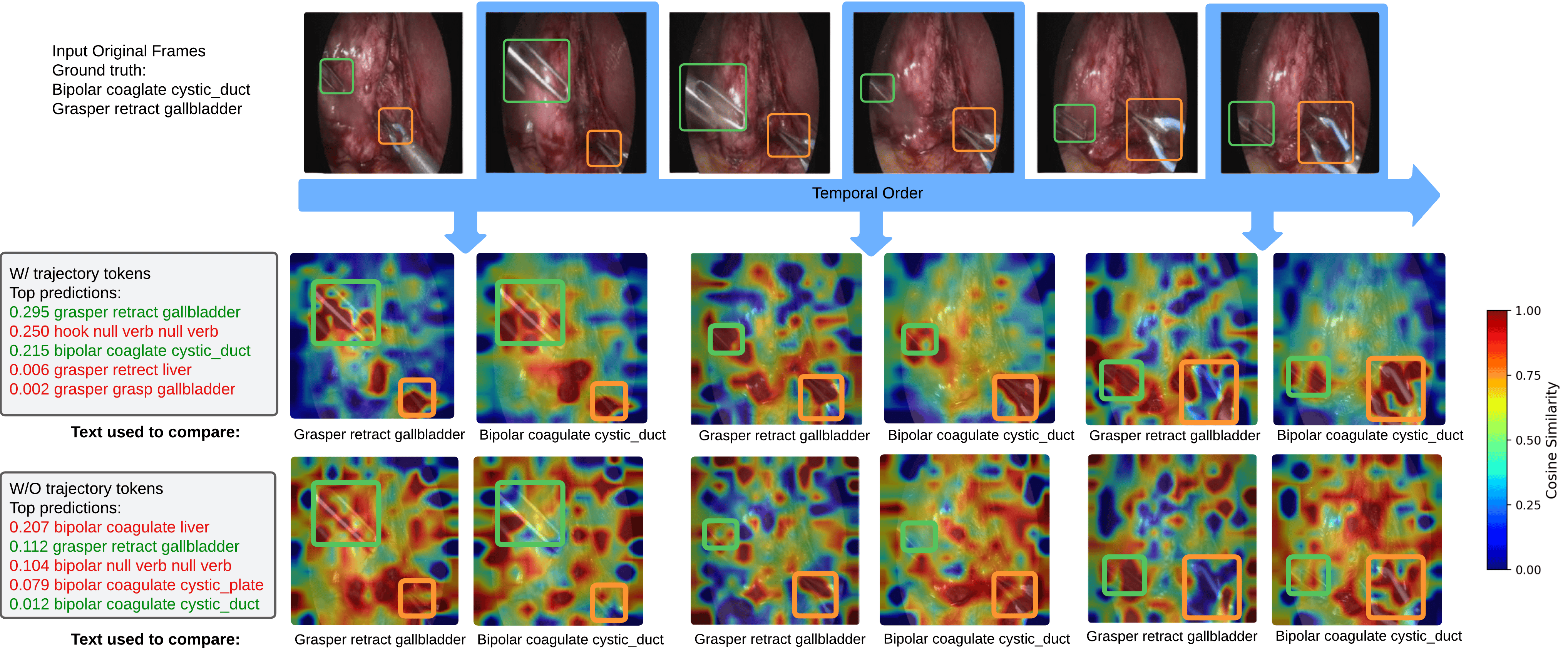
We also investigate whether visual embeddings of instrument–tissue interaction regions align better with the corresponding text by visualizing the cosine similarity between visual and textual embeddings. The visualization results indicate that the proposed method improves alignment between relevant visual and textual representations.
@article{cheng2026trajpred,
  title={TrajPred: Trajectory-Conditioned Joint Embedding Prediction for Surgical Instrument-Tissue Interaction Recognition in Vision-Language Models},
  author={Cheng, Jiajun and Yu, Xiaofan and Tripathi, Subarna and Liu, Sainan and Lin, Shan},
  journal={arXiv preprint arXiv:2603.06999},
  year={2026}
}We identified a bug in our metrics implementation that only affects the CLIP-VIT-L-Patch14-FT (vision encoder frozen) row of Table 2 in the paper. The fix does not change the paper's main claims.
Note: mAP is evaluated with the ivtmetrics zero-positive-video exclusion disabled — videos with no ground-truth positives are included in the per-class average.
| Setting | Method | API | APV | APT | APIVT | Top@|GT| | Top@5 | Top@10 | Top@20 |
|---|---|---|---|---|---|---|---|---|---|
| Standard RDV | CLIP-VIT-L-Patch14-FT (vision encoder frozen) | 61.17 | 44.43 | 29.67 | 11.02 | 55.32 | 77.12 | 88.04 | 93.60 |
| SurgVLP-Full-FT‡ | 71.18 | 47.70 | 33.35 | 12.68 | 59.02 | 81.98 | 88.72 | 94.93 | |
| HecVL-Full-FT‡ | 76.07 | 50.92 | 32.09 | 12.67 | 58.03 | 78.80 | 86.59 | 93.58 | |
| PeskaVL-Full-FT‡ | 75.20 | 48.71 | 30.29 | 12.12 | 57.05 | 76.76 | 86.43 | 93.54 | |
| VL-JEPA (Image) | 72.51 | 49.22 | 31.58 | 12.65 | 60.06 | 81.58 | 90.04 | 95.31 | |
| VL-JEPA (Video) | 82.95 | 55.17 | 34.16 | 13.49 | 61.91 | 79.86 | 88.81 | 94.91 | |
| TrajPred (Ours) | 86.37 | 59.23 | 36.01 | 14.77 | 65.45 | 84.33 | 91.61 | 97.02 | |
| Unseen Verb | SurgVLP-Full-FT‡ | 54.57 | 35.32 | 21.96 | 8.09 | 15.17 | 22.98 | 29.07 | 33.12 |
| HecVL-Full-FT‡ | 60.52 | 35.27 | 23.76 | 8.68 | 16.69 | 25.55 | 30.61 | 34.15 | |
| PeskaVL-Full-FT‡ | 57.92 | 35.79 | 23.70 | 8.54 | 17.73 | 26.97 | 31.95 | 34.91 | |
| VL-JEPA (Image) | 53.73 | 32.04 | 23.94 | 8.28 | 17.53 | 25.65 | 32.29 | 34.85 | |
| VL-JEPA (Video) | 62.33 | 35.97 | 24.88 | 9.02 | 19.39 | 27.67 | 32.93 | 35.21 | |
| TrajPred (Ours) | 74.31 | 43.62 | 26.33 | 11.26 | 20.88 | 28.14 | 32.99 | 36.27 |
Contact: Shan Lin
Lab Address:
Goldwater Center 381
650 E. Tyler Mall
Tempe, AZ 85287-5706
© 2025 MARGIN Lab. All rights reserved.