Latent-Action-Guided Vision–Language Contrastive Learning for Surgical Interaction Recognition
1Arizona State University · 2University of California, Merced · 3Intel Corporation
The current arXiv posting is an earlier version of this work, titled LAVIFT: Latent-Action-Guided Vision Fine-Tuning for Surgical Interaction Recognition. An updated version is in preparation.
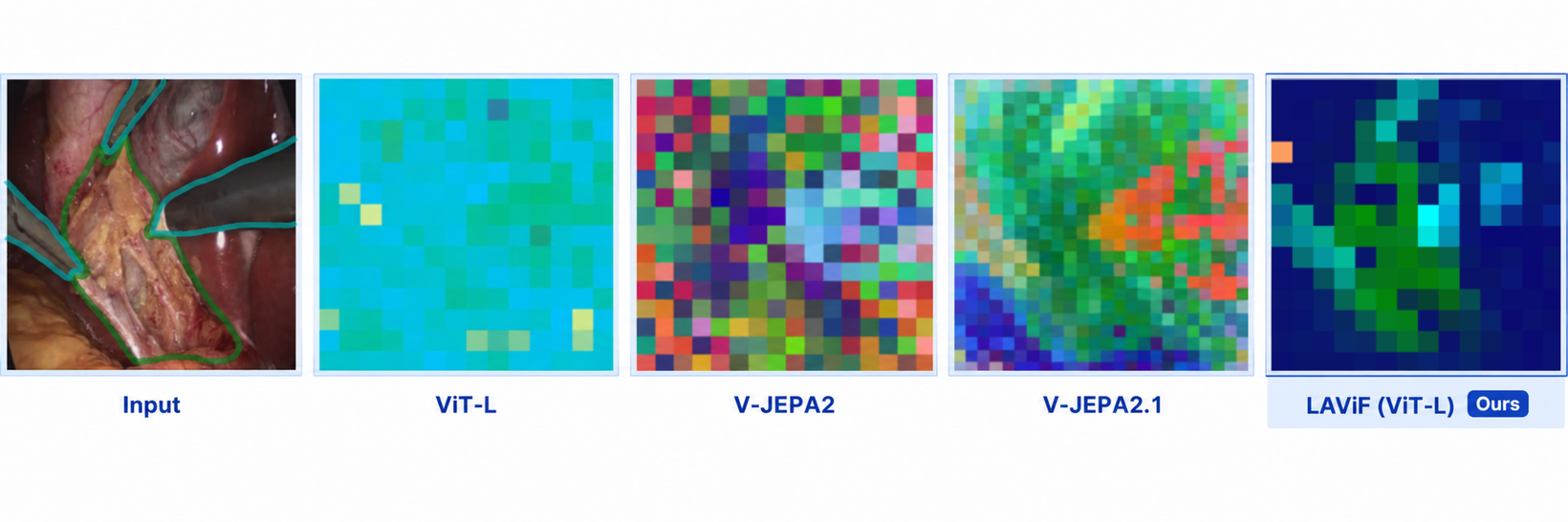
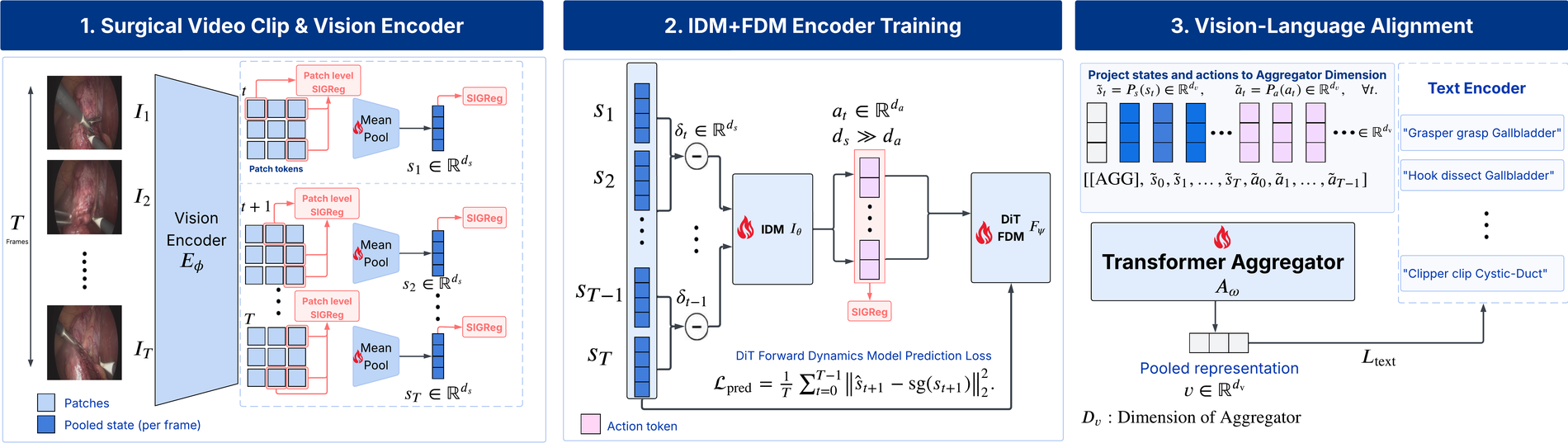
Pretrained encoders often lack spatial coherence, and global vision–language alignment does not guarantee precise spatial or temporal structure. LAViF compresses frame-to-frame feature changes into latent actions and predicts next-frame features during end-to-end video–language alignment. Without extra spatial or motion annotations it improves interaction grounding and temporal-direction sensitivity, and with ordinary image encoders reaches competitive recognition at higher throughput and smaller INT4 drops than V-JEPA2/2.1.
| Method | mAPIVT | mAPI | mAPV | mAPT | mAPIVT | mAPI | mAPV | mAPT |
|---|---|---|---|---|---|---|---|---|
| CholecT50 (RDV) | ProstaTD (5-fold) | |||||||
| Published task-specific methods | ||||||||
| Rendezvous†△ | 29.90 | 92.20 | 60.07 | 38.30 | – | – | – | – |
| Chain-of-Look†△ | 38.00 | 94.10 | 62.50 | 41.90 | – | – | – | – |
| MML-SurgAdapt† | 30.30 | 87.30 | 61.10 | 43.20 | – | – | – | – |
| TDNet†◇△ | – | – | – | – | 36.10 | 89.90 | 61.70 | 55.70 |
| Controlled baselines — general-domain pretraining | ||||||||
| CLIP ViT-L/14† | 26.17 | 86.26 | 62.54 | 42.93 | 26.80 | 90.97 | 65.00 | 53.51 |
| DINOv2-L† | 27.41 | 90.08 | 65.28 | 45.44 | 36.01 | 93.13 | 70.75 | 63.84 |
| V-JEPA2‡ | 29.68 | 92.16 | 68.55 | 47.97 | 32.66 | 91.30 | 71.89 | 59.95 |
| V-JEPA2.1‡ | 34.82 | 93.99 | 69.76 | 50.23 | 35.87 | 94.36 | 74.35 | 62.64 |
| TimeSformer‡ | 27.32 | 88.67 | 64.69 | 44.43 | 29.43 | 86.19 | 64.69 | 56.14 |
| Controlled baselines — surgical-domain pretraining | ||||||||
| EndoViT† | 24.71 | 85.19 | 61.41 | 41.23 | 26.94 | 88.35 | 62.02 | 53.63 |
| LEMON† | 28.71 | 87.34 | 65.04 | 44.70 | 32.26 | 91.72 | 66.51 | 59.71 |
| SurgVLP† | 20.28 | 73.96 | 52.33 | 37.76 | 20.64 | 78.07 | 52.45 | 45.88 |
| HecVLP† | 21.41 | 77.59 | 57.23 | 39.29 | 22.42 | 81.16 | 55.89 | 48.76 |
| PeskaVLP† | 22.02 | 79.20 | 57.22 | 39.26 | 23.09 | 82.45 | 56.99 | 50.75 |
| LAViF — ViT-L | 32.15 | 93.24 | 68.29 | 47.05 | 32.82 | 92.82 | 68.28 | 60.63 |
| LAViF — DINOv2-L | 33.13 | 94.60 | 68.91 | 48.81 | 38.14 | 96.03 | 73.01 | 65.21 |
| LAViF — SurgeNet-L | 32.78 | 95.02 | 71.64 | 50.89 | 38.85 | 96.74 | 72.82 | 65.73 |
Best instrument, verb and target mAP on CholecT50, and best triplet, instrument and target mAP on ProstaTD — from image encoders without large-scale video pretraining. Chain-of-Look still leads CholecT50 triplet mAP, using a task-specific classification head. ProstaTD values are five-fold means.
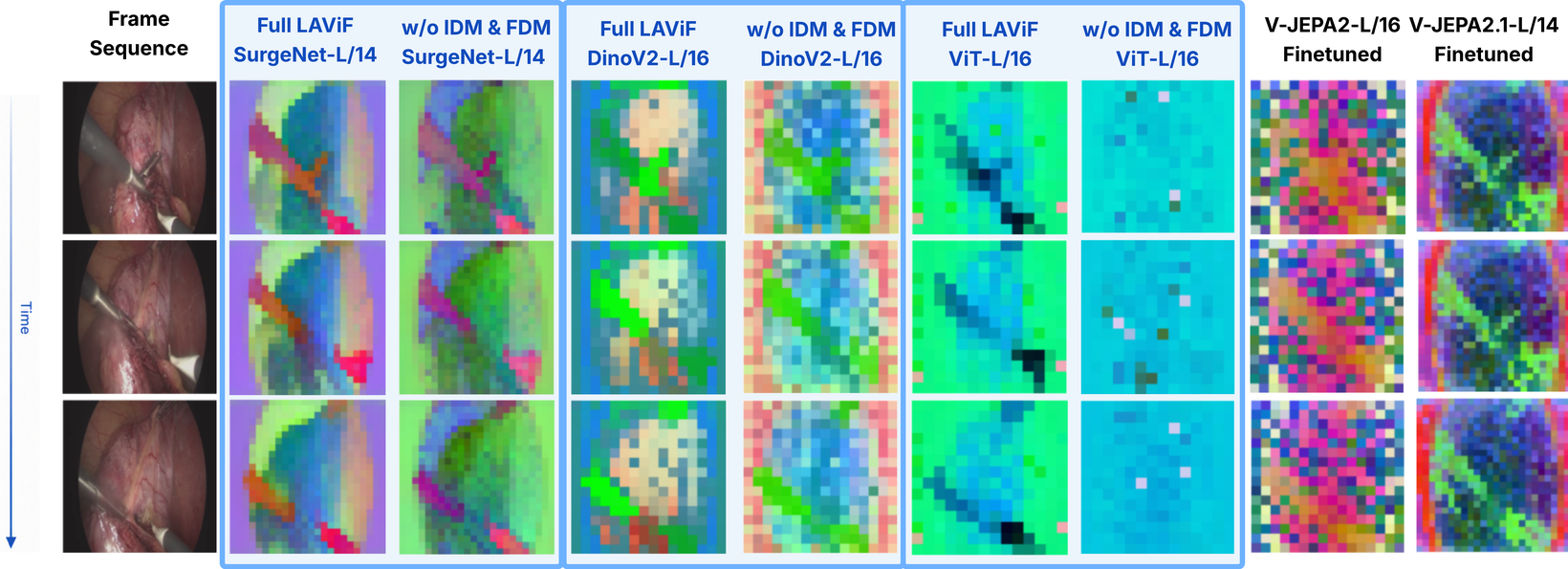
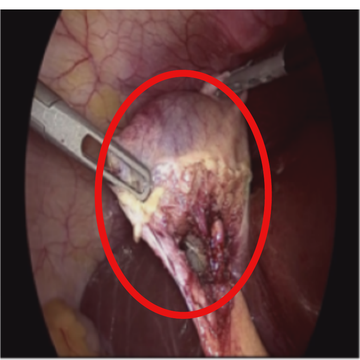
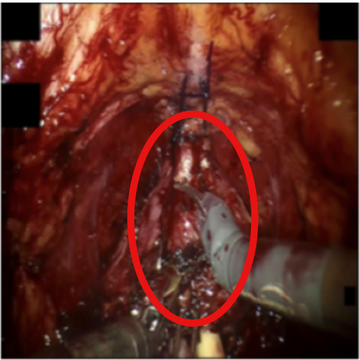
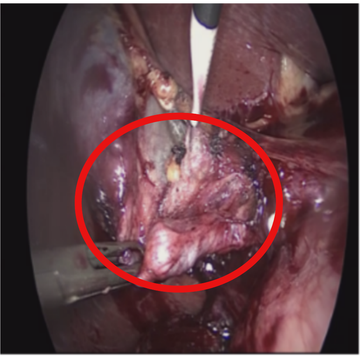
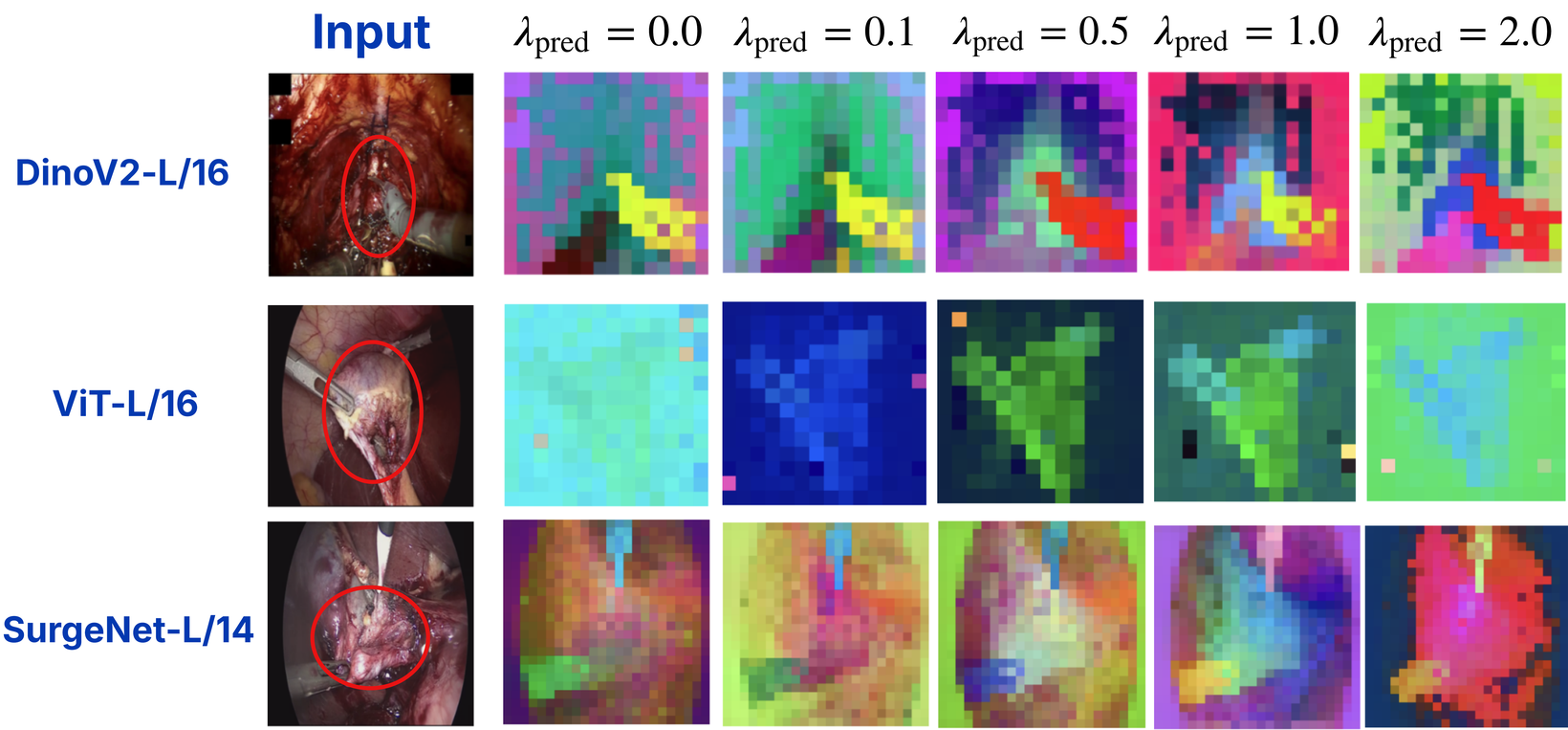
λpred swept at fixed da = 128. Predictive pressure reorganizes local structure for every encoder, but unevenly: going 0 → 1 gains ViT-L 2.81 verb / 1.40 triplet mAP and SurgeNet-L 1.75 verb / 1.51 target mAP, while costing SurgeNet-L 0.79 triplet mAP.
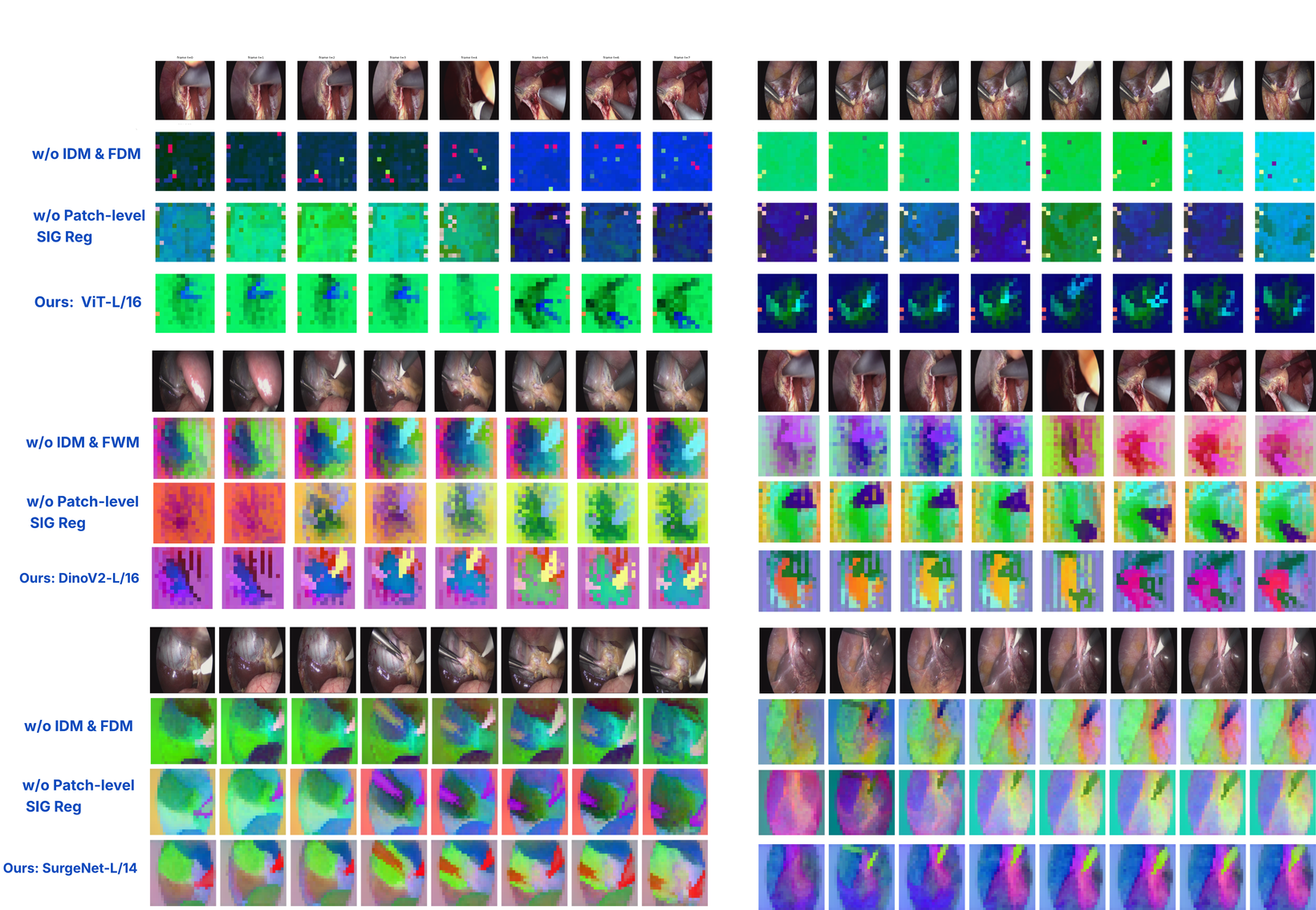
LAViF encodes frames independently, so attention cost is linear in clip length, O(T·P2 + T2), against O(T2·P2) for spatiotemporal encoders — the gap widens with longer clips.
| Model | Attention | Res. | Params | Latency (ms) ↓ | Throughput (clips/s) ↑ | Memory (GB) ↓ |
|---|---|---|---|---|---|---|
| Ours (per-frame) | ||||||
| LAViF — ViT-L | per-frame | 224 | 304M | 13.7 | 72.8 | 7.5 |
| LAViF — DINOv2-L | per-frame | 224 | 304M | 19.7 | 50.8 | 10.9 |
| LAViF — SurgeNet-L | per-frame | 224 | 304M | 41.5 | 24.1 | 20.2 |
| Video baselines (spatiotemporal) | ||||||
| V-JEPA2 | spatiotemporal | 256 | 326M | 68.1 | 14.7 | 15.4 |
| V-JEPA2.1 | spatiotemporal | 384 | 305M | 96.2 | 10.4 | 22.0 |
| TimeSformer | spatiotemporal | 384 | 305M | 94.3 | 10.6 | 22.0 |
At ~300M parameters, ViT-L and DINOv2-L reach 50–73 clips/s, about 3.5–5× the spatiotemporal baselines (≤ 14.7). SurgeNet-L is slower at 24.1 clips/s, still above every video baseline.
| Encoder | Variant | ΔI | ΔV | ΔT | ΔIVT |
|---|---|---|---|---|---|
| ViT-L | Ours | −0.9 | −0.8 | 0.0 | −2.7 |
| No IDM+FDM | −0.1 | −0.5 | −2.9 | −4.2 | |
| DINOv2-L | Ours | −0.3 | −0.2 | −0.1 | −2.8 |
| No IDM+FDM | −0.5 | −0.9 | −0.9 | −4.2 | |
| SurgeNet-L | Ours | −0.1 | −0.6 | +0.2 | +0.4 |
| No IDM+FDM | −0.2 | −1.0 | −0.5 | −1.3 | |
| V-JEPA2 | Base | +0.2 | −2.4 | −3.9 | −7.7 |
| V-JEPA2.1 | Base | −2.4 | −4.8 | −4.7 | −5.6 |
@article{cheng2026lavifit,
  title={Latent-Action-Guided Vision-Language Contrastive Learning for Surgical Interaction Recognition},
  author={Cheng, Jiajun and Liu, Sainan and Tripathi, Subarna and Yu, Xiaofan and Lin, Shan},
  journal={arXiv preprint arXiv:2607.19889},
  year={2026}
}
Contact: Shan Lin
Lab Address:
Goldwater Center 381
650 E. Tyler Mall
Tempe, AZ 85287-5706
© 2025 MARGIN Lab. All rights reserved.